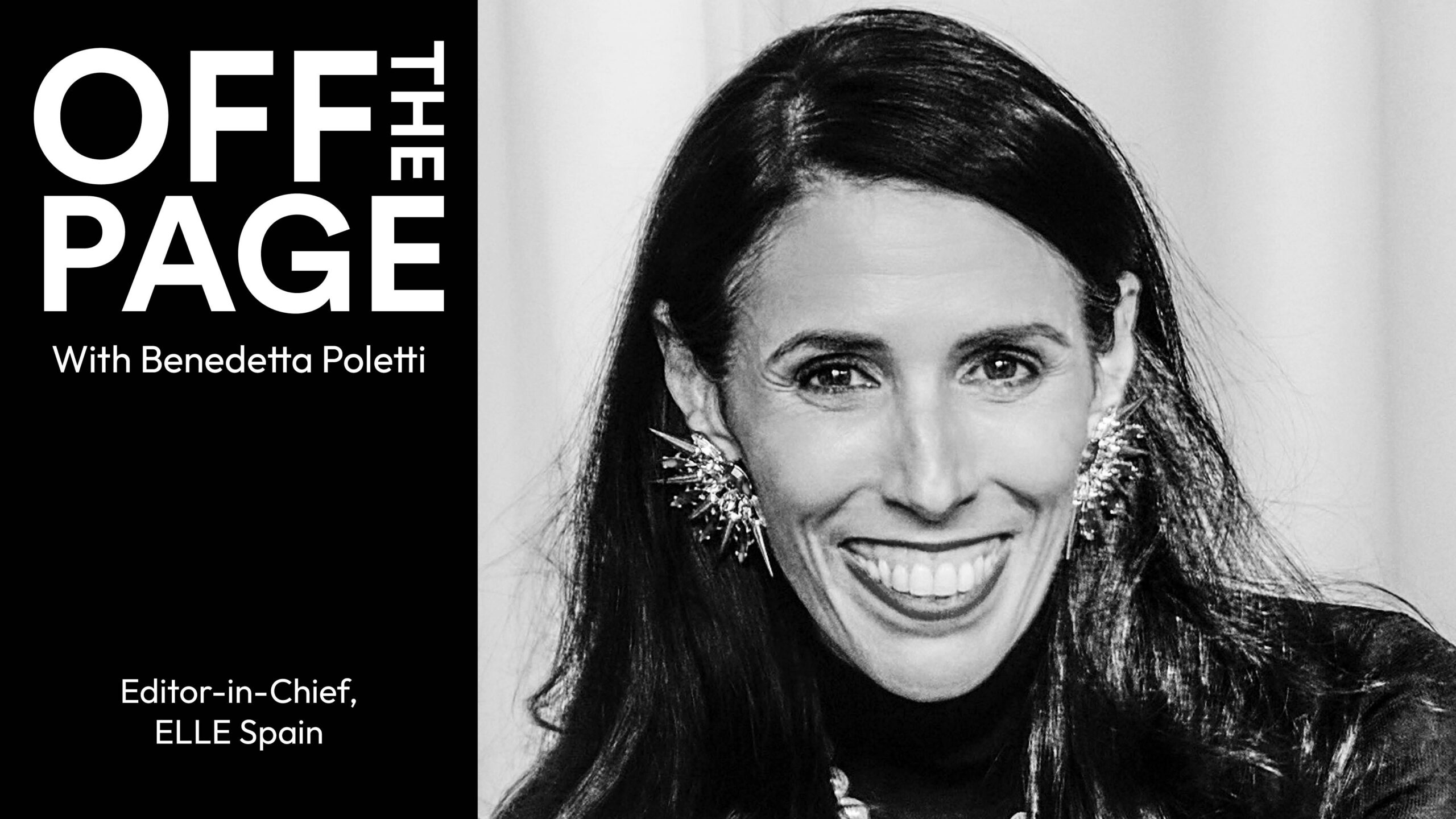
Welcome back to “Off the Page,” where we spotlight the editorial leaders behind Hearst’s global brands. Our latest interview features Benedetta Poletti, Editorial Director of Hearst Spain and longtime Editor-in-Chief of ELLE Spain. An Italian by birth and a Madrileña by choice, she brings a unique cross-cultural perspective to the relationship between global brands and local audiences.
Through decades of transformation across fashion, media, and culture, Benedetta has remained guided by a simple belief: great media is build not only on information, but on emotion, trust, and human connection. In conversation, she reflects on balancing global consistency with local relevance, the power of cultural identity as a driver of innovation, and why editorial judgment matters more than ever in an age defined by algorithms and AI.
You’ve led ELLE Spain for nearly two decades while also shaping the editorial vision across all Hearst brands in Spain—a country with a strong sense of identity, creativity, and emotion in how fashion and culture are expressed.
How do you ensure that this distinct voice is not diluted within a global brand ecosystem, but instead becomes a point of strength and differentiation? And looking back, how has your understanding of what makes a truly resonant global brand evolved—and what have you learned about adapting that vision to the cultural rhythms of Spain?
I’ve always believed in the importance of being glocal, finding the right balance between a global vision and a deep local connection. The strength of an international brand like ELLE lies precisely in its ability to embrace global conversations while translating them through voices that genuinely resonate with the local audience, across print and digital platforms.
As you say, Spain has a unique emotional language and a very distinctive attitude towards life. Fashion here is never just about aesthetics; it’s about identity, self-expression and a certain art of living. Our mission has always been to bring the ELLE DNA—its optimism, irreverence, curiosity and joy—into Spanish culture: it’s a beautiful mix of global vision and local soul.
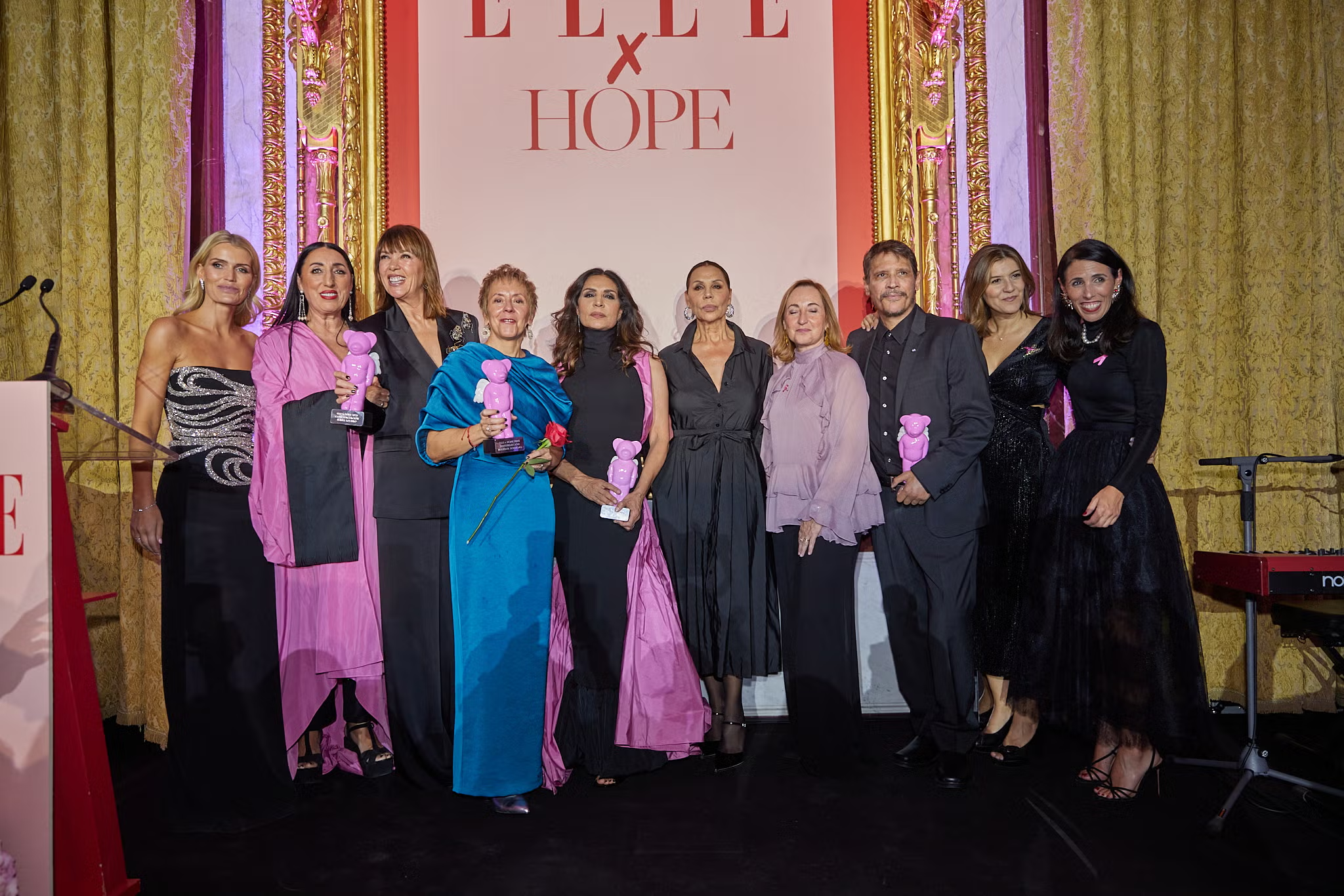
For me, it has always been essential that ELLE plays an active role in society, not simply reflecting culture, but helping shape it, leading conversations and supporting meaningful causes. Whether through women empowerment initiatives, sustainability projects or committed events such as the ELLE Cancer Ball, I’ve always wanted ELLE to be more than a magazine: a meaningful brand with purpose.
Over time, I’ve realised that a truly global brand is not one that looks identical everywhere, but one that feels emotionally relevant everywhere. And relevance only comes from listening deeply to each culture and trusting local intuition.
Today, in the age of AI and infinite scroll, what truly differentiates a media brand is no longer access to information—everyone has access. What matters now is perspective, emotional intelligence and trust. For years, journalists were almost hidden behind logos; today, paradoxically, individual voices, editors and trusted storytellers have become more essential than ever. They are the real guarantors of credibility.
A brand becomes powerful when it stops being just content and starts becoming emotional memory. People no longer want to simply consume stories; they want to feel part of them. That’s why we’ve moved from storytelling to storyliving: creating experiences, conversations and moments people genuinely remember.
As an Italian who has built both a professional and personal life in Madrid, you bring a uniquely cross-cultural perspective to your work. How has living between cultures influenced your editorial instincts and the way you interpret global narratives for a Spanish audience?
Living between cultures has shaped everything I do. Being Italian gave me an instinctive sensitivity to beauty, fashion, detail and craftsmanship. Madrid added something equally important: freedom, warmth, spontaneity and emotional openness—although I still need my Spritz and pizza!
That duality allows me to read global narratives through a more nuanced lens: understanding what resonates universally and what needs cultural translation. Spain doesn’t consume content passively: it feels it. And that has profoundly shaped my editorial instinct. I’ve learned that information alone is never enough. Emotion creates memory, and memory creates connection. I always ask myself not only: “Is this relevant?” but “Will this move people emotionally?”
Today, audiences are searching for much more than information. They are searching for meaning, inspiration and connection. Especially in challenging times, we must also offer hope. As García Márquez once said, “The best news story is not always the one reported first, but the one told best.” In a world saturated with algorithms, journalism must remain a bastion of authenticity. It is no longer just about communicating; it is about making people feel something.
Global brands often walk this fine line between consistency and cultural specificity. Can you share an example of when honoring local identity in Spain meaningfully reshaped a global editorial direction—and what that taught you about leadership?
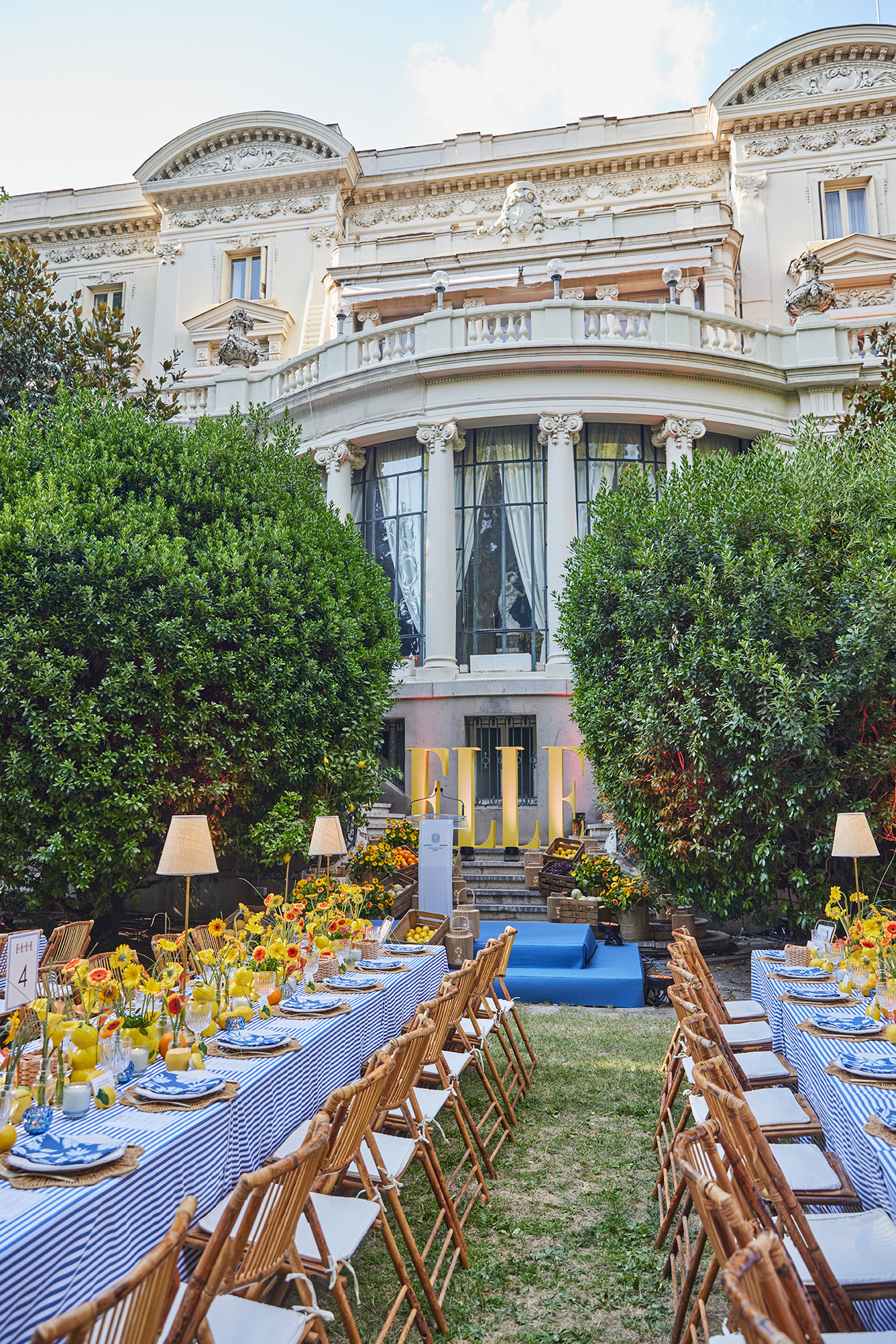
A great example was the launch of ELLE Gourmet. In Spain, food is almost a religion. We celebrate around a table, both joy and heartbreak. Food here is not simply gastronomy; it is identity, memory, creativity, pleasure and love. We also created the ELLE Gourmet Awards, a major summer event in a beautiful garden celebrating not only great chefs and restaurants, but also bon vivants, healthy initiatives, sustainability and the Mediterranean spirit that makes Spain so unique. And what started as a deeply local idea eventually inspired other international editions to create similar projects. That experience taught me that local identity is never a limitation for a global brand…it’s often its greatest source of innovation.
You’ve overseen moments of profound change in fashion, media, and society—from print dominance to digital-first, from trend-led storytelling to values-driven narratives. What has remained essential in your editorial philosophy throughout these shifts, regardless of platform or market?
So much has changed—platforms, rhythms, algorithms, consumption habits—but one thing remains essential: quality. Editorial excellence never goes out of style. Good content is still king.
I truly believe we are what we read. Quality and credibility remain everything. Technology changes constantly, but trust does not. AI is extraordinary at processing information and delivering answers, but human beings create meaning. Journalism still matters because great journalists know how to ask the right questions and that requires intuition, empathy, sensitivity and cultural understanding. That is what allows certain stories to transcend the page and become part of the collective conversation.
In today’s world, saturated with noise and misinformation, human editorial judgment has become more valuable, not less. Readers are no longer simply looking for speed; they are searching for trusted voices and meaningful perspectives.
As Editorial Director across multiple Hearst titles, your role requires balancing many perspectives—creative, commercial, and cultural, not to mention giving autonomy to the respective brand editors-in-chief. How do you help inform decisions when global priorities and local intuition don’t immediately align?
I’m incredibly fortunate because Hearst Spain has some of the best editors-in-chief imaginable: deeply committed to their brands, loyal to the company’s values and genuinely supportive of one another. There is very little ego and a great deal of collaboration—which, in media, is rare and precious.
My role is about connecting perspectives, encouraging creativity and creating an environment where talent feels trusted and empowered. Leadership today is not about imposing; it’s about creating alignment while protecting individuality. I often say that great editors need both soul and spine. Soul, because media is about empathy, emotion and human connection. Spine, because credibility requires rigor, ethics and courage. Especially today, when audiences are overwhelmed by content but starved for meaning.
With the rapid changes in media and growing global interconnectedness, the role of an editor-in-chief has expanded well beyond content oversight. From your experience, what have been the most important shifts in the role, and how have they shaped the way you lead?
Today, an editor-in-chief no longer simply oversees pages or content. We are cultural curators, community builders and emotional translators.
Paradoxically, in a world increasingly shaped by AI, the role has become far more human. We are no longer simply producing content; we are creating experiences, conversations and moments people remember.
Being an editor today requires vision, intuition, emotional intelligence, creativity, adaptability and an enormous amount of passion and energy! Media never sleeps. Inspiration can come from everywhere anytime: a film, a trip, a conversation. At the same time, we must inspire our teams in an extremely fast-changing world, help them to embrace excellence, creativity and the Wow effect. And also, to engage with the audience. Readers expect much more from a magazine today. They want experiences, values, authenticity and community. They want to feel part of something. We are no longer simply writing stories; we are building relationships.
Quick-Fire Round…
An object you carry with you always, i.e., a notebook, signature lipstick, perfume, or something else that feels almost like a personal talisman.
A notebook. I’m obsessed with all types of notebooks…I still need to write ideas by hand. And lipstick—even in chaos, lipstick helps.
After a long day during fashion week, Coffee in Milan or apéritif in Paris?
I’m Italian, so Milan is always home. But honestly? A glass of champagne overlooking the Seine in Paris after a long day is hard to beat.
A trend you loved before everyone else—and still miss a little (or a lot!)
Ballet flats. I will defend flats forever.
Your most used word.
Bravissima!
Your most-used word in an editorial meeting.
Can we make it more emotional?
A book, film, or song you return to when you need inspiration.
The Little Prince. It reminds me never to lose curiosity, tenderness or wonder—qualities that become revolutionary in adulthood.
Last question...when the pace slows, how do you hope people remember the way you made them feel—those you worked with, mentored, or quietly influenced? And what do you hope quietly carries your imprint forward?
I hope people remember me as someone who made them feel seen, inspired and emotionally connected — both professionally and personally. At the end of the day, titles disappear, trends change and careers fade. What truly remains is how you make people feel.
I would love my legacy to be not only the magazines or brands I helped build, but the people I encouraged, trusted and helped grow along the way. Because media, at its best, is not about content. It’s about human connection. And as Maya Angelou once said, people will forget what you said, people will forget what you did, but they will never forget how you made them feel.